
How to achieve a perfect flush track and common mistakes to avoid
With UK searches for the term ‘indoor outdoor living’ increasing 51% year-on-year according to Google Trends, there is a growing demand for seamless transitions between indoor and outdoor living.
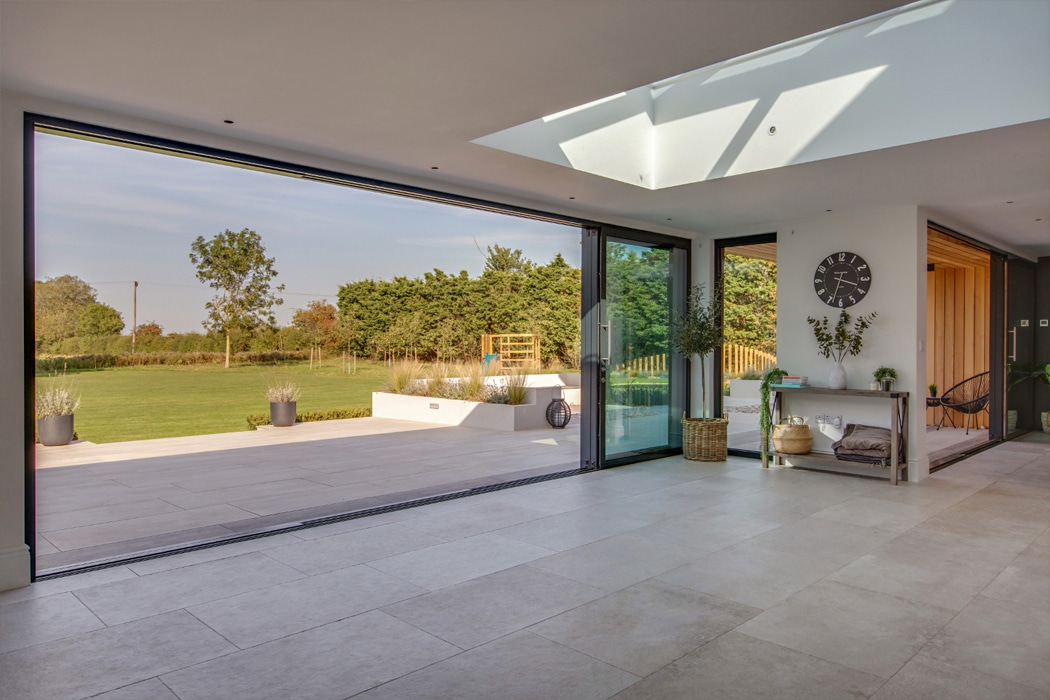
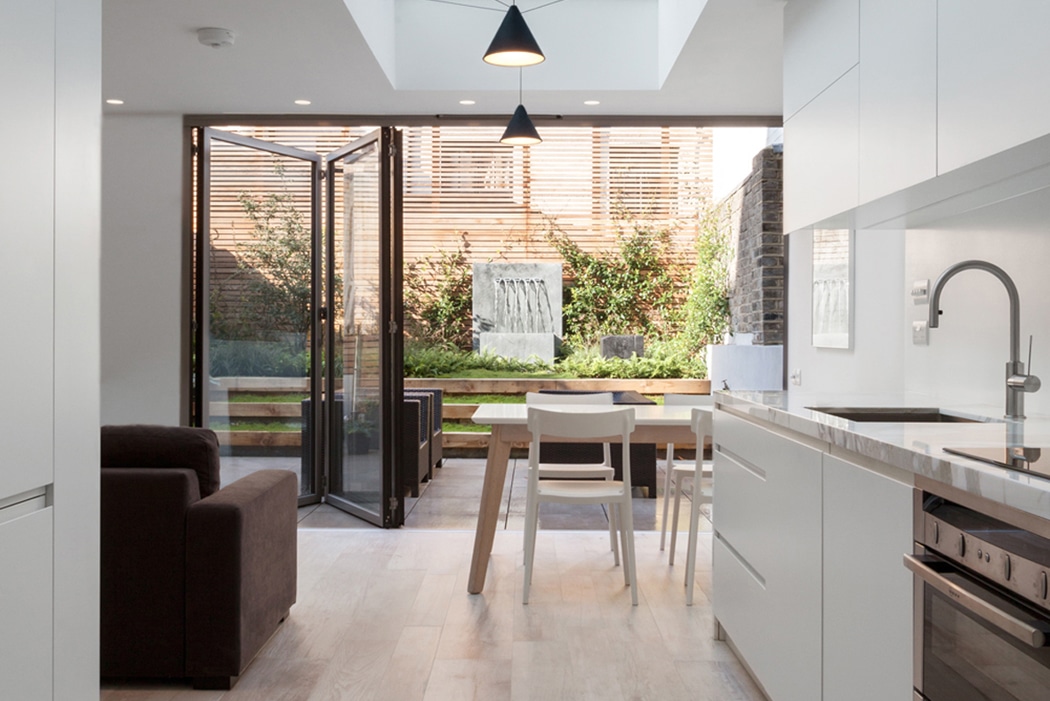
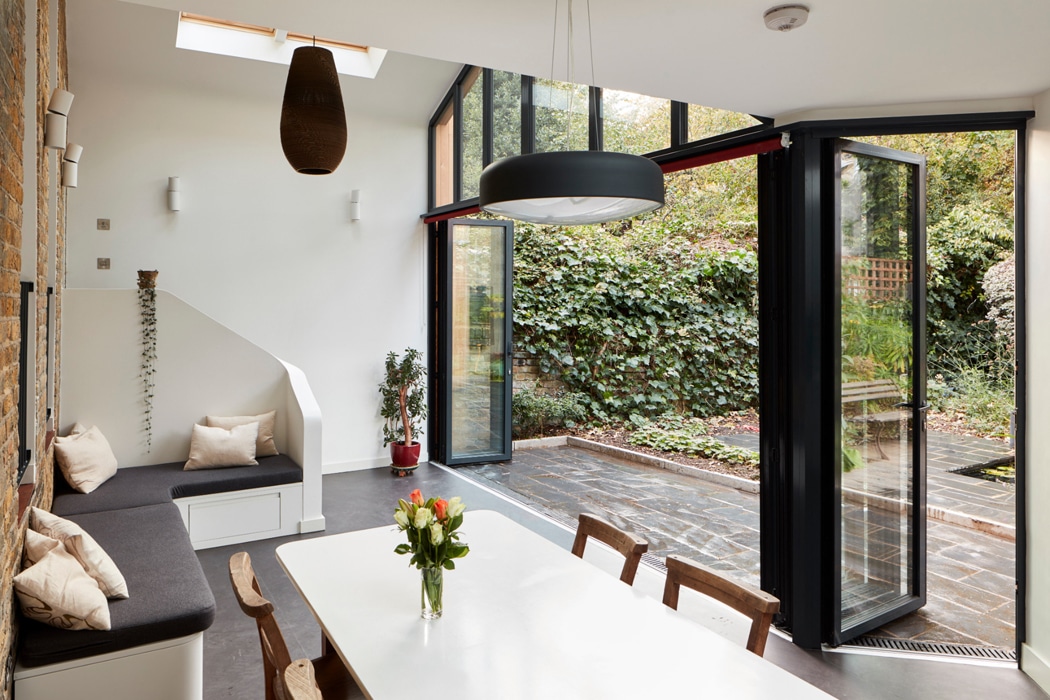
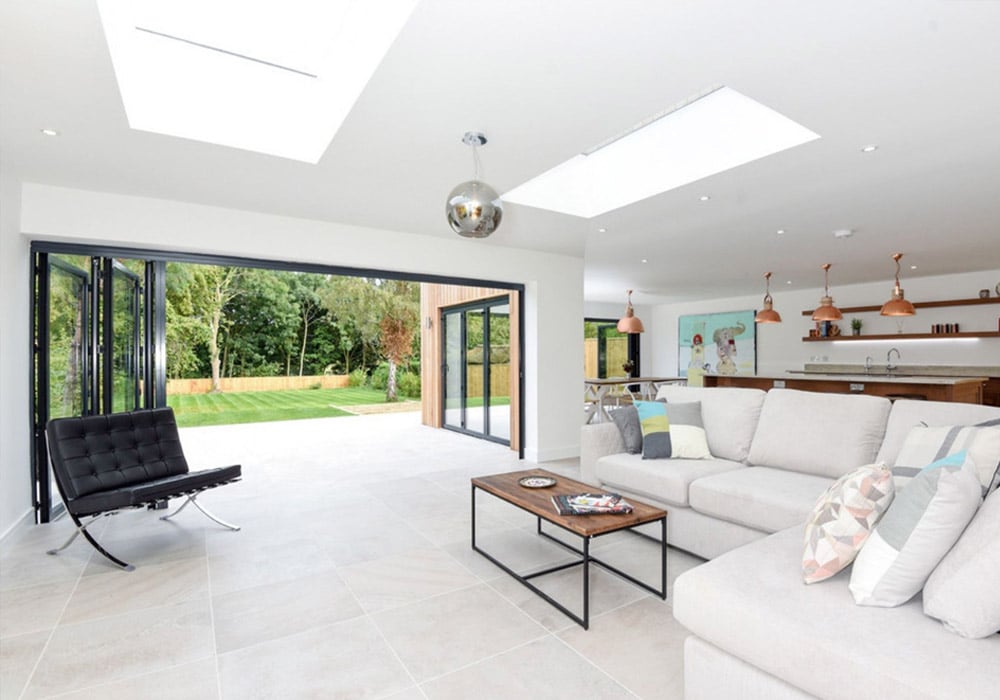
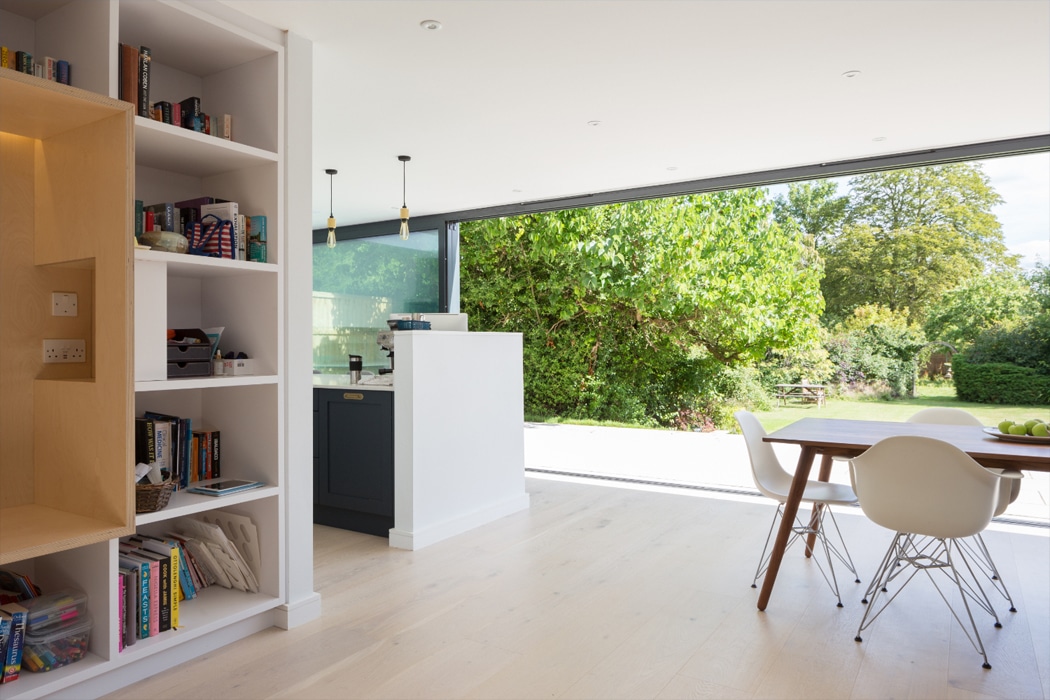
Glazed doors with a flush track fit perfectly in this trend, allowing you to literally open your house up to the garden with minimal sightlines and no obstructions to the outside world.
External flush track door systems are a relatively modern innovation for residential homes in the UK, having gained significant popularity over the past 10-15 years. The trend for flush tracks comes in part from styles employed in countries with warmer and more settled climates, where internal tiled floors were more common, and water ingress was less of a concern.
Traditionally, the British climate has meant that drainage over a sill took precedence over a seamless appearance, as external doors require a frame or threshold to close against to provide an effective weather seal. However, new innovations now make it possible to achieve a flush finish that can withstand our wet weather.
“Flush tracks have become increasingly popular, particularly on larger apertures for sliding and bifold doors,” says Edward Stobart, IDSystems Technical Sales Manager, “They now account for more than 70% of total IDSystems installations – but they are still relatively rare for existing doors and older homes.”
Flush track doors are not the standard option in the UK, but they are a design-driven upgrade that is much more typical on high-end and contemporary homes, rather than the more typical home improvement job.
As flush tracks require higher technical precision than traditional thresholds, without expert guidance, this can unfortunately lead to mistakes that are costly and time-consuming to correct.
Having worked on over 40,000 projects designing, manufacturing, supplying, installing and supporting, IDSystems has been at the forefront of mastering these complex installations since their inception. Our Technical Sales Manager Edward Stobart supported countless projects, including those where previous mistakes have had to be corrected. Below, he highlights the most common flush track mistakes and how to avoid them.
- Which types of doors can have a flush track?
- The most common mistake: when the flush track is not actually flush
- How to ensure the perfect flush finish
- Stick to your vision of uninterrupted views
Which types of doors can have a flush track?
Some systems are designed to achieve a flush finish with a solid weather seal, and others need at least a low threshold to seal against. Knowing the difference can make or break your project. Below, we have outlined considerations for a range of doors, but if you’re still unsure, the IDSystems team is on hand to help.
| Door type | Can it be completely flush? | Technical details |
|---|---|---|
| Sliding doors | Yes | no upstand – panels sit down in track |
| Slide & turn doors | Yes | no upstand – track fitted with ‘flipper seals’ |
| Bifold doors | Visually flush | 14mm upstand, complies to Part M of Building Regs for wheelchair access |
| French doors | Visually flush | 14mm upstand, complies to Part M of Building Regs for wheelchair access |
| Front doors | Visually flush | 14mm upstand, complies to Part M of Building Regs for wheelchair access |
| Fully weathered bifold and French door track | Not recommended | 35mm upstand, for more exposed coastal and rural conditions |
Perfectly flush: Slide and turn systems

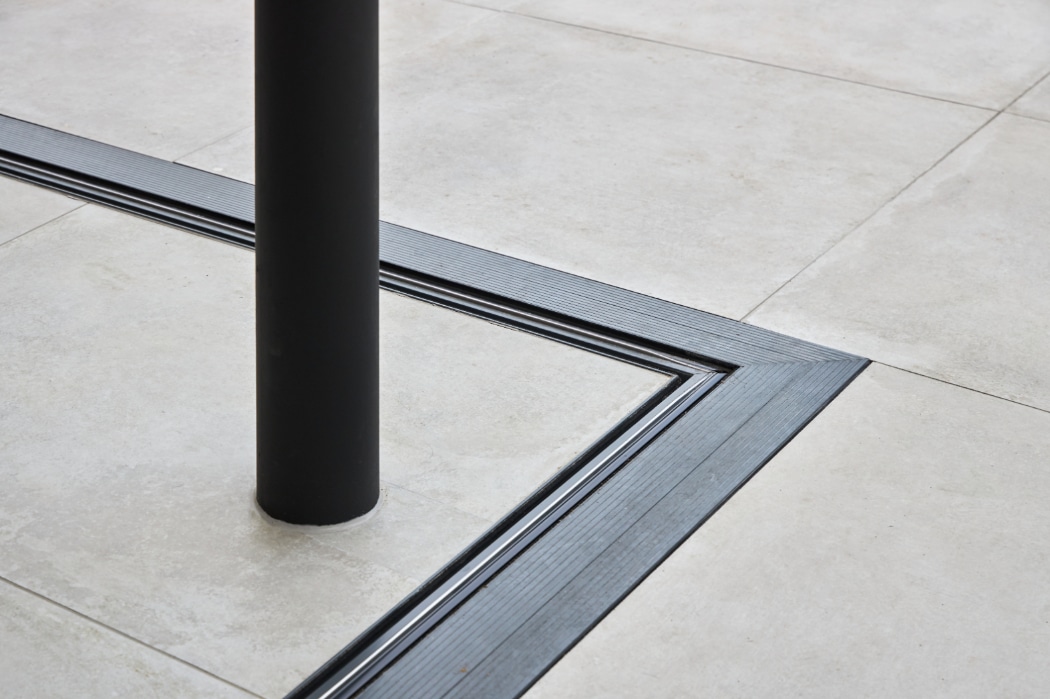
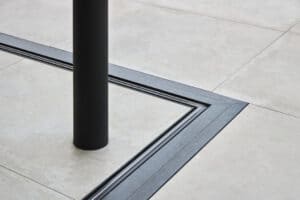
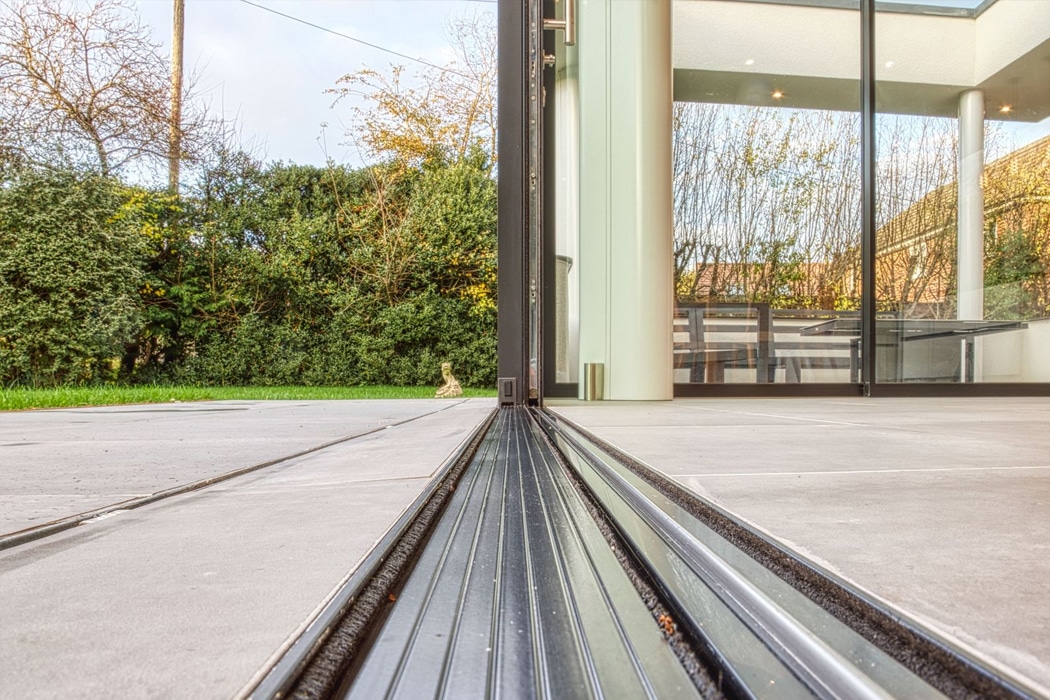
Sliding doors and slide & turn doors can have a 0mm upstand, meaning the height of the sliding track is completely flush with the outdoor and inside flooring. These systems achieve a weather seal due to their unique sealing mechanisms.
For sliding doors, the panels slide on running carriages set down into the track, so a weather seal is achieved.
On slide & turn doors, like the vistaline system, the flush track is designed with flipper seals that turn when the doors are locked shut to create a weather-tight barrier between inside and out.

Visually flush: Bifold and French doors

Bifold and French doors close into the track or upstand. While it is possible to purchase completely flush track bifold and French doors with no upstand, in those instances, the only connection between the bottom of the panels and the track is brush pile, which is not an effective method of preventing drafts and rain.
Installing a completely flush track on external bifold or French doors would likely cause damp and flooding issues. Therefore, IDSystems would only advise bifold and French doors with a completely flush track for internal applications, where weather sealing is not required.
For external applications, IDSystems advises the use of a threshold, providing a seal to keep out drafts and water ingress. Fortunately, this doesn’t mean you need to compromise on your flush dreams, using low thresholds for a visually flush effect.
For example, our bifold doors are manufactured with tracks that are designed with a small 14mm upstand, against which the panels close. This upstand is barely noticeable, complies with Building Regulations Part M for wheelchair access, and still appears to be almost completely flush when viewed from inside and out.


The most common mistake: when the flush track is not actually flush
The risks of a flush track set at the wrong height are both aesthetic and practical.
- A track that is set too high, even by a few millimetres, can be a trip hazard, especially if the interior and exterior flooring is level and the track protruding is not obvious.
- Visually, the track sticking out also spoils the much sought-after seamless transition between inside and out that so many are looking for.
- If the track is sunken into the ground, it is more likely to pick up dirt and debris, which can cause operational faults over time.
- There is also a risk of drainage issues, as it can act as a gutter for rainwater.
The flush track is too high
The most common mistake when trying to achieve a flush track finish is the track sticking out above the flooring. Unfortunately, this is also the issue that is usually the most difficult to fix.
Stobart explains: “Typically, if the track is too high, it is because the base has been built up too much. To fix this issue, it would have to be lowered by digging out the base and reforming it to the correct height.
“Unfortunately, this is time-consuming and, more importantly, will have a knock-on impact throughout the rest of the ground floor of the finished floor height.”
“For a new-build, this may be possible, but for an extension where you are likely to be matching the floor height of the existing house, it is far more challenging. If it is not possible, the likely result would be the track sitting slightly above the level of the finished floor.”
The flush track is too low
Stobart explains: “When the track is too low, we have the potential ability to pack underneath the frame to bring the height of the track up to match the finished floor level.”
“However, how much it can be raised is dependent on the size of the doors and the tolerance allowed for at the head of the system.”
If you want to raise the bottom track, the entire door panel has to raise with it. There is a certain amount of ‘wiggle room’ (the technical term is tolerance) at the top of the door to allow for smooth operation and small changes in structural settling of the building over time.
It’s not possible to raise the track beyond the tolerance of the system, without changing the size of the opening.
How to ensure the perfect flush finish
Choose your flooring early
Stobart notes that it is only possible to measure correctly when you know exactly what there is to measure: “Not only is it important to know the depth of track to ensure that the door system is suitable for your aperture, it’s crucial that you make decisions on internal and external flooring materials so that the flooring finishes flush with the track.
“Deciding after you’ve ordered the doors that you want a solid wooden floor that is 20mm deep instead of the 10mm ceramic tile that you had originally planned would likely scupper the whole flush finish. Knowing the impact of the decisions you make is the most important thing.”
Work with experienced suppliers and installers
It is also important to keep in mind that flush track finishes are far from standard features in UK houses. Therefore, not every builder or installer will have the relevant experience to achieve a perfectly flush track.
To ensure that you’re working with experienced installers and suppliers, it’s always a good idea to request images of their previous work.

Communicate clearly about the details
Stobart warns that one of the main reasons behind flush track mistakes is a miscommunication about the finished floor level: “Where the opening is being surveyed prior to manufacturing, it is crucial that the finished floor level (including the chosen floor finishes) are communicated to the surveyor so they are incorporated within the calculations of the aperture sizes.”
Stick to your vision of uninterrupted views
While the technical requirements of a flush track are more demanding than a standard threshold, the aesthetic payoff is undeniable. Stobart notes that because these systems require such high levels of precision, you may occasionally find that some contractors or builders are hesitant to install them: “I was on site recently and the builder had originally tried to talk the client out of having a flush track because it meant more work and detail for him – but the client stuck to their guns and in the end the project looks so much better for it.”
Ready to bring your vision to life? Get in touch with the IDSystems team today to discuss your dream project and find the perfect flush track solution for your home.

Gallery